
Signs Your Floor Finish Is Ready for Waxing
Wax is what gives a resilient floor its shine, and it is the first layer to wear. By the time a floor looks dull from across the room, the coating has usually thinned out in the busiest lanes. These are the signals that the finish needs a wax top-up rather than a full strip:
- A sheen that disappears within days of buffing
- Patchy or uneven finish through entrances and corridors
- Black heel marks and cart streaks that keep returning
- Finish that scuffs white or powders off underfoot
- Yellowing, peeling or flaking finish near edges and doorways
- Mopping more often just to keep the floor looking clean
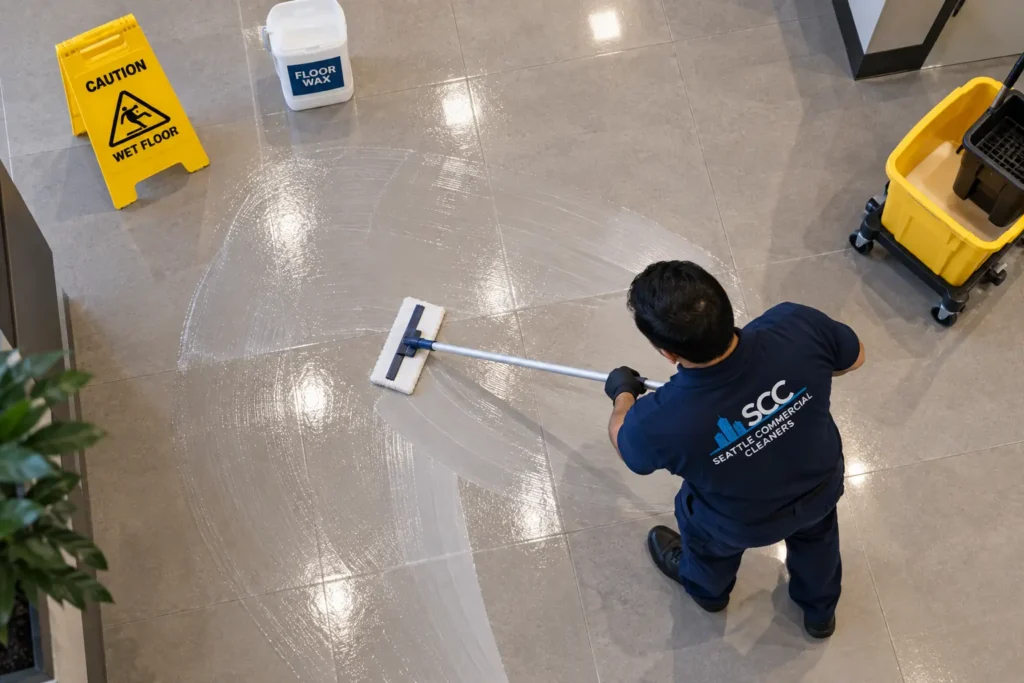
What Our Commercial Floor Waxing Service Includes
No two floors age the same way. A proper waxing program either revives a tired surface or keeps a healthy one glossy with scheduled top-ups, and we match the finish and the number of coats to your floor instead of selling one fixed package.
We start by identifying the floor type and how hard it works. A superstore entrance, a warehouse aisle and a restaurant dining room each call for a different finish, coat count and reapplication interval. Where the finish has worn down to the bare floor, the honest answer is floor stripping first and new wax after, not another coat on top of a failing one.
- Application of commercial-grade floor finish
- High-speed buffing and burnishing
- Top scrub and recoat to refresh worn lanes
- Slip-resistant finish options
- Scheduled wax programs for high-traffic sites
- Recurring finish maintenance with a care log
Beyond the floor itself, we handle disinfection, pressure washing, high dusting and other commercial cleaning for the same buildings, so floor care can sit inside one maintenance plan instead of three separate vendors.
Tell us what services you need, and Seattle Commercial Cleaners will happily accommodate you.
Commercial Floor Waxing for High-Traffic Lanes
A finish always fails first along the paths people actually walk. Entrances, corridors, reception areas and the route between them take constant foot traffic all day, so the wax thins there long before the open floor shows any wear.
Good floor care accounts for that. Rather than re-waxing an entire building on one schedule, we target the lanes that wear first with buffing, burnishing and recoating, so the whole floor stays visually even and you are not paying to redo areas that are still healthy.
Exterior doors are the other weak point through a Seattle winter. Rain, grit and road salt ride in on every set of shoes, so entrance lanes lose their shine fastest and need the most attention. Matting, a tighter entrance schedule and spot buffing protect those areas between waxing visits. We regularly work with:
If your facility also needs broader interior cleaning, see our janitorial services and commercial deep cleaning options.
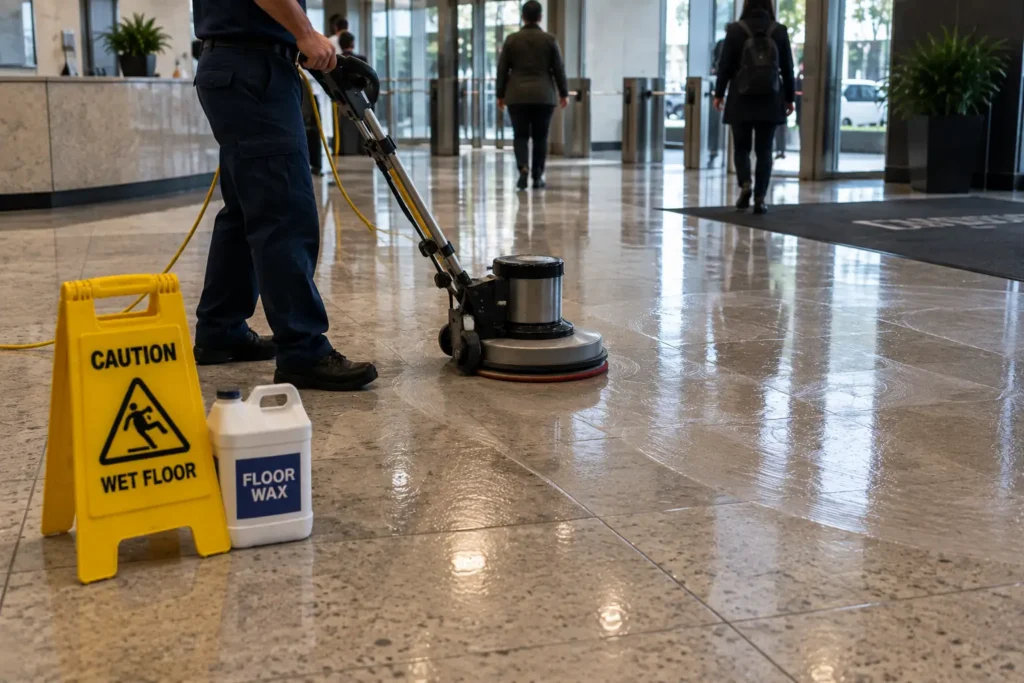
Our Commercial Floor Waxing Process, Step by Step
Because floor type, existing finish, square footage and operating hours all change the plan, the scope is built around your building rather than a generic checklist. Here is how a waxing job runs from start to finish:
1. Walkthrough and Test Areas
We map each floor type and traffic lane, check how much finish is left, and test a small area to confirm the product and coat count. You get a written scope and a fixed quote before anything starts.
2. Protect the Space
Furniture is moved or masked, transitions are taped, and baseboards, carpet edges and nearby walls are protected. We post wet-floor signage and set up so the work can run without disrupting the rest of your building.
3. Deep Clean the Surface
The floor is scrubbed and rinsed to strip away soil, scuffs and any loose finish, because new wax will only bond to a genuinely clean surface. Edges, corners and under fixtures are hand-detailed.
4. Apply the Wax in Thin Coats
Finish goes down in thin, even coats, usually three to five depending on traffic, with full dry time between each one. Thin coats build a harder, clearer film than a few heavy passes, which is why the result stays glossy instead of turning hazy.
5. Cure, Then Burnish
After the final coat cures, we burnish the floor with a high-speed machine. Burnishing hardens the finish, brings up the gloss and leaves a smoother surface that resists scuffing and marks.
6. Final Walkthrough With You
We inspect the work with you under normal lighting, checking for an even coat, clean edges and no missed areas, and correct anything on the spot before we pack up.
7. Set the Maintenance Cycle
Finally we set the cycle that keeps the floor looking new: routine dust mopping, burnishing every few weeks and a top scrub and recoat before the finish wears through, all based on your traffic and appearance standards.

How Often Should Commercial Floors Be Waxed?
Waxing is a cycle, not a one-off job. As a working guide, high-traffic sites such as schools, grocery entries and retail stores are re-waxed every 6 to 12 months, general offices every 12 to 18 months, and low-traffic areas can stretch longer. In between, burnishing every 4 to 6 weeks and a top scrub and recoat each quarter keep the shine up without a full strip. Your real interval comes down to:
- Daily care: dust mopping and correct cleaning products decide how long the wax lasts between visits.
- Foot traffic: entrances and corridors wear fastest and can need recoating before quieter rooms.
- Property type: customer-facing spaces such as retail and hospitality usually demand a higher standard of shine.
- Season: Seattle rain, grit and road salt are tracked in through the wet months and dull finishes faster.
- Spills and staining: food, drink and high-contact areas may need more frequent spot attention.
- Appearance standards: some sites need a consistent gloss year-round, which shortens the interval.
Industries We Serve


Services Provided
-
 Janitorial Services
We will determine your needs and customize your service, but our janitorial service includes tasks such as sanitizing and cleaning restrooms and lunchrooms, dusting cubicles, mopping floors, vacuuming carpets, cleaning windows, trash removal, re-stocking items, etc.
-
 Window Cleaning Services
Our experienced team of professionals will assess your building, access points, foot traffic, and surrounding conditions to determine the safest and most effective way to remove pollen, water stains, dirt, and buildup from your windows.
-
 Pressure Washing
Our commercial, high-power pressure washing will rid your outside surfaces of dirt, grime, mold, and will give the exterior of your buildings a fresh, clean look.
-
 High Dusting Services
Our team will reach all of those hard-to-get spots and remove the dust, allergens, and dirt that can build up in these locations so you don’t risk trying to reach these areas.
 Janitorial Services
 Window Cleaning Services
 Pressure Washing
 High Dusting Services

Wax or Strip? How to Choose
Waxing and stripping are not the same job, and choosing the wrong one wastes money. Waxing builds a protective finish on top of a floor that is still sound. Stripping takes the old finish all the way back to the bare floor when it is too yellowed, built up or worn to save.
Most buildings need both over time. Waxing and buffing maintain the surface in between, and an occasional strip resets the floor when the finish is beyond saving. Quick test: if the finish is peeling, badly yellowed or worn through to the tile, plan for floor stripping first and wax after. If it is simply dull and thin, waxing is the cheaper answer.
Two related reads: the benefits of hiring a commercial floor cleaning company, and how commercial cleaning costs work.
For carpeted areas and other soft surfaces, visit our commercial carpet cleaning page rather than treating every floor type as part of the waxing scope.
Which Commercial Floors Can Be Waxed
Wax and finish are made for resilient floors with a smooth, sealed surface. On the right floor they build a hard, clear film that protects the material and makes daily cleaning faster. We apply and maintain finish on:
Some surfaces should never be waxed. Ceramic and porcelain tile, natural stone and polished concrete are cleaned, sealed or polished instead, and vinyl with a factory wear layer is not meant to take a floor finish at all. Wax will not bond to those surfaces and can trap dirt or leave a haze. If waxing is the wrong call for your floor, we will say so and point you to the service that actually helps.
- Vinyl composition tile (VCT)
- Linoleum and sheet vinyl
- Luxury vinyl tile with a finish-compatible wear layer
- Commercial-grade sealed hardwood
Why a Waxing Schedule Protects Your Floor Investment
A finished floor is an asset with a replacement date attached. Left alone, grit acts like sandpaper underfoot, the wax wears through, and the tile underneath starts to take the damage that wax was there to prevent. A planned waxing and burnishing schedule is what pushes that replacement date out.
- Keep the wear on the wax, not on the tile underneath.
- Cut down on trapped soil and residue to keep the building cleaner and safer.
- Hold an even shine across entrances, corridors and open floor.
- Delay an expensive floor replacement and keep the budget predictable.
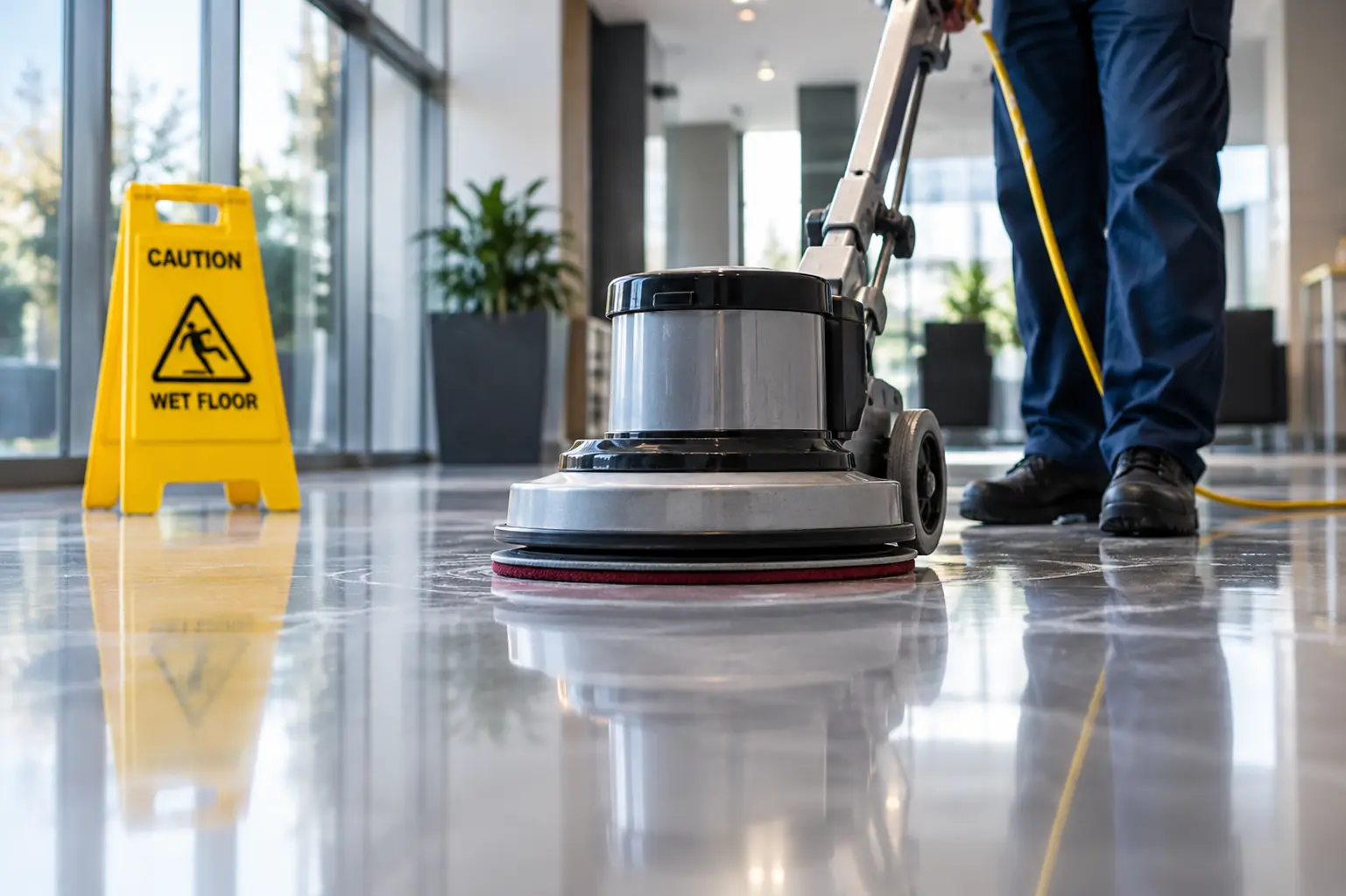
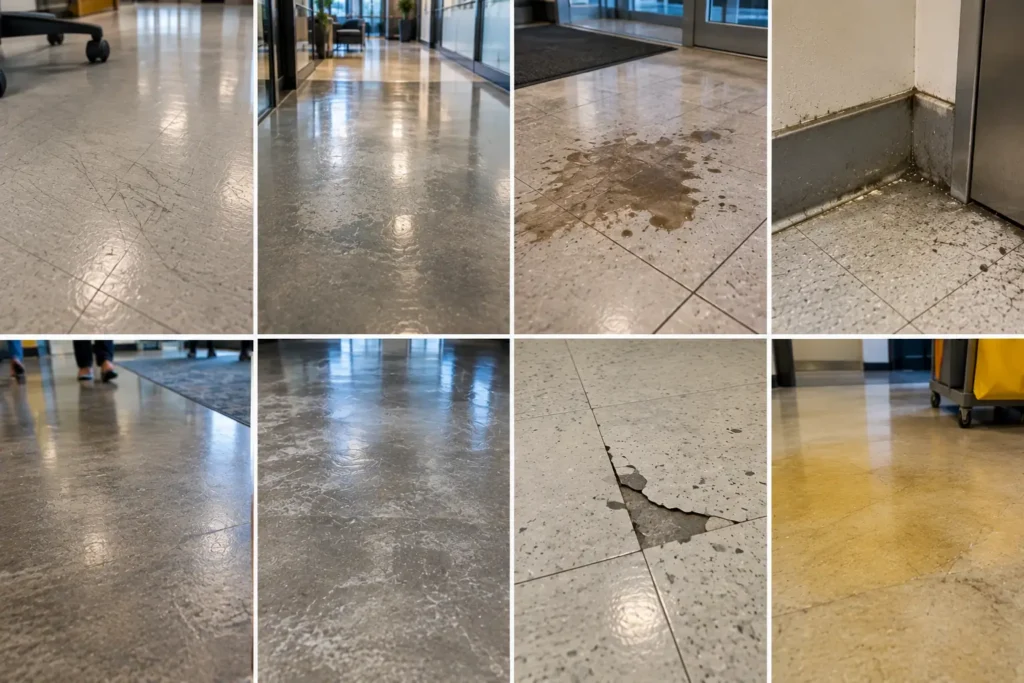
Floor Finish Problems We Diagnose and Fix
When a finished floor starts to look tired, it is usually one of a handful of finish problems. These are the ones we see most in Seattle buildings:
- Finish that has gone dull or hazy in the busiest lanes.
- Black heel marks and cart streaks that no longer buff out.
- Yellowed or built-up finish that holds onto dirt and looks dirty even after cleaning.
- Powdering or flaking finish around edges where traffic turns.
- Entrances that look scuffed and worn within days of a clean.
What Affects the Cost of Commercial Floor Waxing
There is no flat per-square-foot price for waxing, because the work follows the building rather than a menu. When we quote a job, these are the things that move the number:
We put the scope and the price in writing after a walkthrough, so you can compare quotes on the same set of tasks instead of guessing what is and is not included.
- Square footage and the number of separate floor areas to be treated.
- Floor type, because VCT, linoleum and sealed hardwood each take a different product and pace.
- The condition of the existing finish and how much prep and cleaning it needs first.
- The number of coats, which rises with traffic and with how much shine you want.
- Furniture and fixtures, and how much of the space has to be moved and protected.
- Access and hours, including after-hours or weekend work that keeps your business open.
Caring for a Waxed Floor Between Professional Visits
Most of the wear between waxing visits comes down to what happens day to day. A few simple habits keep the finish looking fresh far longer, and they are free:
We can leave product guidance and a short care sheet with your team, and pair it with a scheduled burnishing or recoat program so the floor never has to fall all the way back to a full strip.
- Dust mop or sweep daily so grit does not grind into the finish.
- Use entry mats and keep them clean, especially through Seattle’s wet months.
- Damp mop with a neutral cleaner, never an all-purpose or citrus degreaser, which strips wax.
- Blot spills straight away and skip vinegar, ammonia and abrasive pads.
- Label your cleaning products so the wrong one is not grabbed in a hurry.
Why Use Seattle Commercial Cleaners?
Seattle Commercial Cleaners is a family-owned and operated company that has served the Seattle metro area since 2012. We are one of the region’s longest-running commercial cleaning teams, and our floor waxing and finish work is built on trained, insured technicians, up-to-date equipment and current safety standards.
- Local since 2012: more than a decade of commercial cleaning across Seattle, Bellevue, Renton, Kent, Tacoma and the surrounding area.
- Trained and insured technicians who use up-to-date equipment and follow current safety standards.
- English and Spanish speaking staff.
- Members of ISSA, the International Window Cleaning Association, BOMA and other industry organizations.
- Free, fast quotes, a written scope and a satisfaction guarantee on every job.
- Every floor waxing job is handled by a technician trained for that specific floor type.
- A portion of every scheduled job supports Seattle Humane, The Ocean Cleanup or Seattle Children’s.
You can read more about our team, see the industries we serve, or check the areas we cover. Ready to book? Request a free floor waxing quote.
Reviews
Ryan and his crew positively assured my concerns about safety and the type of work to be performed. Deck cleaning and entire house washing with excellent results and superb clean-up done all in one day. I Highly, highly recommend it.
The team was very responsive to our time-sensitive project. We will definitely be using them in the future for our other retail units. Professional communication and quality work!
We just had our windows washed. I highly recommend their business. We found them to be prompt and friendly. Their work is excellent. We have many windows, 59 to be exact, and they all look beautiful. Their prices are extremely reasonable.
Benefits of working with us:
- We are highly trained for each cleaning task, including commercial floor waxing.
- We use safe, industry-standard products and follow your facility’s product preferences.
- We schedule around your operating hours, including after-hours floor waxing.
- One point of contact for scheduled waxing, burnishing and one-off floor work.
- We learn your floor, your traffic and your standard of shine, and keep the service consistent.
- Our floor finish is judged on the details, and that is exactly where we spend the extra time.

Green Cleaning Products

Highly Qualified Cleaners

We Get the Job Done Right

Satisfaction Guaranteed
Contact us today for a fast quote from our friendly, experienced team. Let us take floor care off your facilities team’s plate.
To schedule floor waxing, call us at (206) 755-2949 or visit our contact page.
Seattle Location





Frequently Asked Questions:
How often does a commercial floor need waxing?
Waxing runs on a cycle. High-traffic sites such as schools, grocery entries and retail stores are usually rewaxed every 6 to 12 months, general offices every 12 to 18 months, and low-traffic areas can go longer. Burnishing every 4 to 6 weeks and a top scrub and recoat each quarter stretch the finish between full waxing jobs. We set the exact interval after a walkthrough.
Can you wax over an existing finish, or do you have to strip first?
Sometimes. If the finish is thin and sound but simply dull, we can top scrub and recoat, or clean and add fresh coats over it. If it is peeling, badly yellowed or heavily built up, new wax will not bond properly and the right move is to strip it back first, then wax. We test a small area and tell you honestly which one your floor needs.
Is a freshly waxed floor slippery?
A cured commercial finish is slip resistant when it is applied and maintained correctly. Finish is slippery only while it is wet, which is why we post signage and keep traffic off the area during application and cure. For entrances and other high-risk spots we can use finish with added slip resistance.
How long is the floor out of use during waxing?
It depends on the product and the number of coats, but thin coats usually dry within about 30 to 60 minutes and the floor can take light foot traffic once the finish has set. We normally work after hours or phase the job so your business stays open, and we confirm the timing for your building in the quote.
Which commercial floors can be waxed?
Wax and finish suit resilient floors: VCT, linoleum, sheet vinyl, luxury vinyl tile with a finish-compatible wear layer, and commercial-grade sealed hardwood. Ceramic tile, natural stone, polished concrete and vinyl with a factory wear layer are cleaned, sealed or polished instead, because wax will not bond to them.