
A commercial high dusting checklist covers every surface above normal reach that daily janitorial work skips: HVAC diffusers, beams, trusses, pipes, cable trays, and light fixtures. A good one also names the tool for each surface, says when a lift is needed, documents the work with photos by zone, and ends with a sign-off your facilities team can audit.
In Seattle, damp air makes fine dust cling to ductwork, and heating systems keep moving it around most of the year. Here’s the checklist we use on Puget Sound jobs.
What does a commercial high dusting checklist include?
A complete checklist lists every overhead surface by zone, the tool and access method for each, protection for items below, and the proof required at the end. Cross out what doesn’t apply during the walkthrough instead of leaving lines blank.
- Supply diffusers, return grilles, and the ceiling tile around them
- Exterior of exposed ductwork, hangers, and straps (top surfaces first)
- Beams, joists, open web trusses, ledges, and window headers
- Exposed pipes, cable trays, and conduit runs
- Pendant, linear, and high-bay light fixtures and lenses
- Ceiling fans and HVLS fan blades
- Exit signs, hanging signage, acoustic baffles, cameras, and Wi-Fi access points
- Tops of tall shelving, lockers, and partitions
Inspect and report only: fire sprinkler heads, smoke detectors, and damaged pipe insulation. NFPA 25 limits how dusty sprinklers can be cleaned, so we photograph them and send them to the building’s fire protection contractor rather than touching them.
Which tools work on each overhead surface?
HEPA vacuums with soft brush heads handle most overhead dust because they capture it instead of knocking it down. Damp microfiber finishes smooth surfaces you can reach. Feather dusters just move dust onto desks and inventory.
| Surface | Tool | Watch out for |
|---|---|---|
| Diffusers and grilles | HEPA vac, then damp microfiber | Leave grilles in place |
| Ductwork and beams | HEPA vac on extension wand | Don’t load duct hangers |
| Timber beams | HEPA vac, soft brush only | No water on raw wood |
| Cable trays | HEPA vac only | Never move cables |
| Light fixtures | Dry, then damp microfiber | Power off and let cool |
When should you use a lift instead of an extension pole?
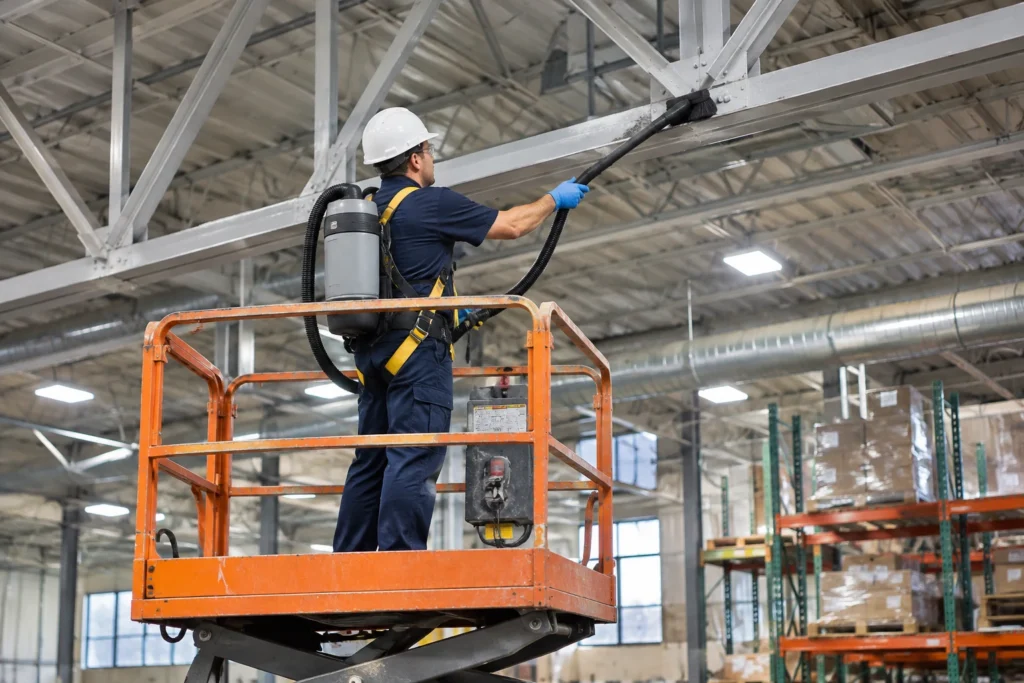
Use a pole when the surface is visible from the floor and the dust is light. Use a lift when you need to see the top of a surface, wipe it, or work over racking and equipment.
Our rule of thumb: if you can’t see the top of a duct or beam from where you stand, a pole will miss it.
Washington adds real requirements. L&I’s elevating work platform rules (WAC 296-869) require operator training, including on the specific lift model, plus training records. Ask your vendor for them. Before bringing a lift in, we also check floor load with the building engineer. Mezzanines and older wood-framed floors are common in Pioneer Square and SoDo commercial buildings, and not all of them are rated for a loaded lift.
How should high dusting be documented with photos?
Split the building into numbered zones, shoot before and after photos from the same fixed spot in each zone, and add one close-up wipe test per zone. Name files by zone and date.
A dark microfiber cloth run along a duct top before and after cleaning is the most honest comparison, because wide “after” shots often look streaky under mixed lighting.

How often should commercial buildings be high dusted?
Most offices need it once or twice a year, retail, gyms, and restaurant dining rooms quarterly, and warehouses every six months. Clinics and facilities with combustible dust should follow their own risk assessments.

These are field starting points, not regulations. Restaurant exhaust systems fall under their own fire code rules, so they need separate kitchen hood cleaning rather than a high dusting visit. Clinics usually schedule overhead work alongside routine medical office cleaning after patients leave. In Seattle, we like one cleaning before heating season and one in spring.
How do facilities teams audit and sign off?
Agree on the scope, zone map, and acceptance criteria before work starts. Review the photo report zone by zone, spot-check zones you choose, and put any failures on a punch list with a correction date.
Your written scope should define the height (for example, everything 8 feet and up), surfaces by zone, exclusions like duct interiors and sprinkler heads, work hours, and who covers items below. Acceptance criteria should be plain: no visible dust on top surfaces, a clean wipe test, and nothing left on the floor. On warehouse cleaning jobs, we always include at least one hard-to-reach bay in the spot check.
What drives the cost of high dusting in Seattle?
Price depends on overhead surface area, ceiling height, lift rental, obstacles, work windows, and how dirty things are on the first visit. Local labor matters too: Seattle’s minimum wage is $21.30 in 2026 and $22.14 starting January 2027.
Like most commercial cleaning costs, high dusting gets cheaper when it’s scheduled regularly, because each visit stays light.
The easiest first step is a walkthrough. Our high dusting team will map your zones and access limits, and we can pair the visit with any other specialty cleaning services your building needs. You can request a walkthrough whenever you’re ready.
Frequently asked questions
Can our regular janitorial crew handle high dusting?
For pole work on diffusers and pendant lights, sometimes. Anything needing a lift is different. Washington requires trained lift operators with model-specific training and records, which most nightly crews do not have. A common setup is the nightly crew handles low dusting and a scheduled visit covers overhead work.
Does high dusting include cleaning inside air ducts?
No. High dusting covers the outside of ducts, diffusers, and grilles. Cleaning inside a duct system is a separate HVAC service. If diffusers get dirty again within weeks of a cleaning, that may point to a filter or duct problem worth raising with your HVAC provider.
Do we need to move inventory before the crew arrives?
Agree on it in the scope. The crew usually covers desks, inventory, and equipment with drop cloths, while you move sensitive items like servers or open food product. In warehouses, plan aisle closures ahead so forklift traffic and lift work do not overlap.
Who pays for high dusting in a multi-tenant building?
It depends on the lease. Lobbies and corridors are usually the landlord’s responsibility and may be billed back through operating expenses. Overhead work inside a tenant’s suite may fall to the tenant or be excluded. Check the lease’s janitorial specs and get the split in writing.
Is high dusting worth it if nobody looks up?
Usually, yes. Overhead dust does not stay put. Airflow and fans bring it down onto desks, products, and floors, and dusty fixtures can reduce light output. In facilities handling combustible materials, built-up dust is also a fire and explosion hazard.