
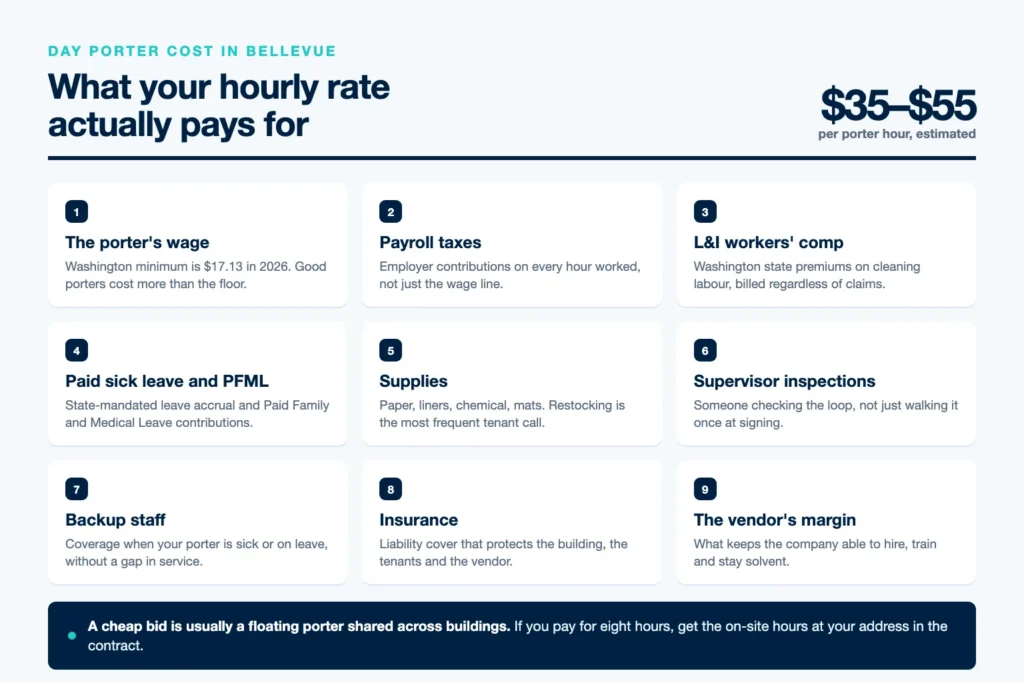
Most Bellevue businesses should budget roughly $35 to $55 per porter hour for contracted day porter service.
That range is our estimate of the current market, not a quote. Where you land depends on shift length, weekly hours, building type, and what the rate includes.
A four-hour weekday porter typically runs about $3,000 to $4,800 a month.
What does a day porter do in a Bellevue building?
A day porter is a cleaner who works on site during business hours, keeping lobbies, restrooms, break rooms, and shared spaces presentable while people are in the building. Your night crew handles the deep cleaning. The porter handles everything that gets messy between morning arrivals and the end of the day.
A typical shift covers:
- Lobby and entry: glass doors, elevator buttons, walk-off areas, and swapping saturated mats.
- Restrooms: checks on a set loop, restocking, wiping counters, and catching clogs or leaks early.
- Spills: coffee in an elevator, a dropped tray in the café, a rain puddle by the door.
- Trash, recycling, and compost: pulling full bins and keeping waste streams separated.
From October through April, the entry is a big part of the job on the Eastside. Rain carries garage grit onto lobby tile, and wet tile is a slip hazard. A porter who swaps mats and sets out wet-floor signs before tenants arrive protects your floors and your liability better than an extra night of mopping.
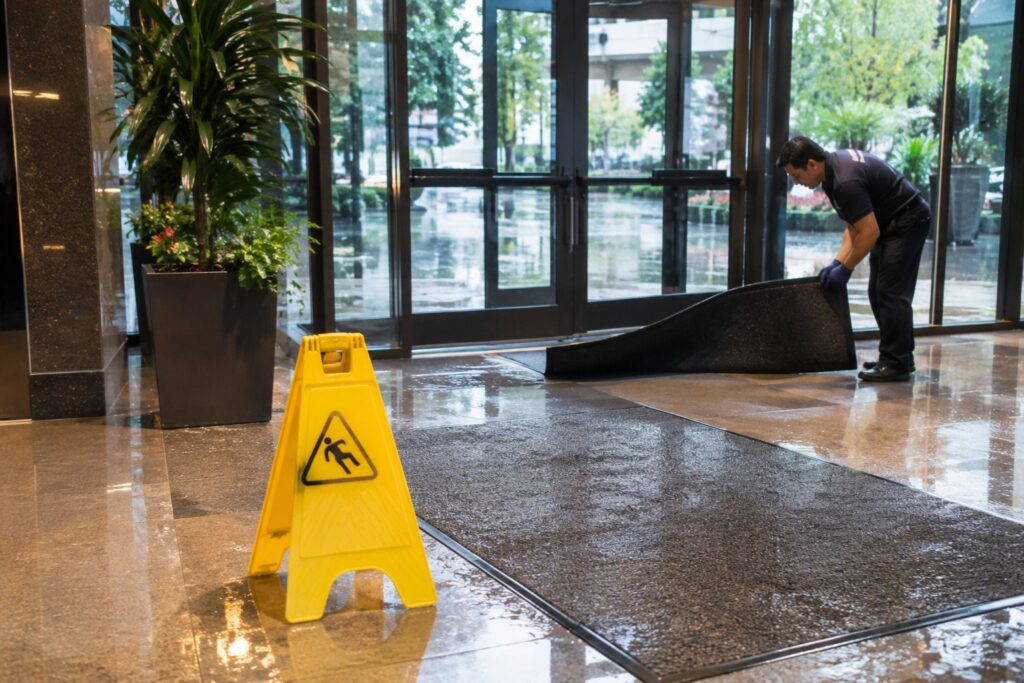
Restocking matters more than most people expect, too. Tenants rarely call because a restroom looks dirty; they call because it’s out of paper towels. That’s why we have porters restock first and wipe second on every loop.
Which Bellevue buildings need a day porter?
Buildings with steady daytime traffic and shared spaces that tenants, patients, or shoppers judge you by. In Bellevue that usually means Class A office towers, medical and dental suites, and multi-tenant retail or mixed-use properties. A 15-person office with one restroom rarely needs one; a night crew plus a midweek touch-up usually covers it.
Class A offices
Tenants paying premium rents expect the lobby to look the same at 3pm as at 8am. Porters focus on lobby glass, elevator cabs, restrooms on every floor, and amenity spaces.
Medical and dental suites
Waiting rooms and patient restrooms need attention all day. Porters here should be trained under OSHA’s bloodborne pathogens standard and know the dwell time of their EPA-registered disinfectant, meaning how long a surface must stay wet to kill the pathogens listed on the label. The most common mistake we see is spraying and wiping immediately. If the label calls for several minutes of wet contact and the surface dries in thirty seconds, it was cleaned, not disinfected. Ask any vendor to show you the dwell time on their product. It’s one reason medical office cleaning calls for different training than a standard office.
Multi-tenant retail and mixed-use
Shared restrooms, food court seating, and garage elevator lobbies in retail and shopping centers get hit hardest at lunch and on weekends. The Spring District, east of downtown near the light rail, is a good example: office floors above ground-level food service push the porter’s busiest hours toward midday. Our approach to commercial cleaning in Bellevue is built around those local traffic patterns.
How much does a day porter cost per hour in Bellevue?
Plan on roughly $35 to $55 per porter hour from a licensed, insured cleaning company. This is an estimate, not a quote. National guides list lower rates, but they don’t reflect Washington labor costs, and the billed rate covers far more than the porter’s paycheck.
Why Bellevue rates run higher
Washington’s state minimum wage is $17.13 per hour in 2026 and rises to $17.73 on January 1, 2027. Bellevue follows the state rate, but Seattle’s 2026 minimum is $21.30. Many porters live on the Eastside and could earn the Seattle floor by commuting, so companies that want to keep good people pay well above the Bellevue minimum.
What the hourly rate pays for
On top of the wage, the rate covers payroll taxes, L&I workers’ comp premiums, Washington paid sick leave and Paid Family and Medical Leave contributions, supplies, supervisor inspections, backup staff when your porter is out, insurance, and the vendor’s margin.
Estimated monthly cost by coverage level
Weekday coverage, about 21.7 days per month:
| Coverage | Hours per month | Estimated monthly cost |
|---|---|---|
| 2 hours a day | about 43 | $1,500 to $2,400 |
| 4 hours a day | about 87 | $3,000 to $4,800 |
| 8 hours a day | about 174 | $6,100 to $9,600 |
| 8 hours a day plus 4 on Saturday | about 191 | $6,700 to $10,500 |
A full 40-hour schedule and a longer contract term push the rate lower. Short shifts, weekend and holiday work, medical-specific training, and rapid-response expectations push it higher. If you’re budgeting for night cleaning too, see our guide to commercial cleaning costs.
How to avoid overpaying
Be careful with a bid that looks unusually cheap. It often assumes a “floating” porter shared across several buildings. If you’re paying for eight hours, get the on-site hours at your address written into the contract.
When you add a porter, rewrite the night scope at the same time. Restroom restocking, lobby glass, and break room wipe-downs often get paid for twice, once at noon and again at 10pm. Removing that overlap can offset part of the porter’s cost.
Which shift pattern fits your building?
Most Bellevue buildings use one of three patterns: 6am to 2pm for buildings that must be ready at open, 8am to 4pm to match office hours, or a split shift that covers the morning rush and a later peak. Choose based on when your traffic actually peaks.
| Shift | Works best for | Watch for |
|---|---|---|
| 6am to 2pm | Medical clinics with early appointments, lobbies that must be ready at open | Restrooms go unchecked after 2pm |
| 8am to 4pm | Standard office towers, amenity floors | Misses pre-open entry work in wet months |
| Split (e.g., 7 to 11am, then 2 to 6pm) | Mixed-use, retail, buildings with lunch and evening peaks | Harder to staff, may cost more per hour |

Don’t forget breaks
Washington requires paid rest breaks and an unpaid meal period on longer shifts, so a “6am to 2pm” shift may really be 7.5 working hours. Ask whether you’re billed for the full span, and who covers restrooms during the porter’s lunch.
How do you scope porter hours by foot traffic?
Start with how many people move through the building and when they bunch up. Time one full cleaning loop, then decide how many loops each part of the day needs. Hours built this way are almost always cheaper than a flat eight-hour default.
- Pull occupancy data from badge swipes, visitor logs, or appointment counts. On hybrid schedules, Tuesday through Thursday often runs far heavier than Friday.
- Walk the loop with a stopwatch and time one complete pass through every zone.
- Set check frequencies by zone. As a starting point, check busy restrooms every 60 to 90 minutes at peak.
- Add a buffer of 10 to 15% for spills and requests, then review after 30 days using complaint and restock logs.
Example: scoping a downtown office
This is an illustrative example, not a client case. Picture a six-floor office with about 400 peak-day occupants and a 75-minute loop. Eight hours Tuesday through Thursday plus four on Monday and Friday saves 8 hours a week over flat full-time coverage, roughly $360 a week at $45 an hour. Our day porter services start with exactly this kind of traffic review.
If your porter keeps running out of supplies mid-afternoon, the fix is usually storage, not more hours. A porter who walks to a basement closet for every refill loses time on each loop. Stage a locked supply shelf on each floor before paying for extra time.
What should you ask a vendor before signing?
- Are the hours dedicated to our building, and who covers sick days?
- Are supplies included or billed separately?
- What training do porters get, including bloodborne pathogens for medical spaces?
- Can you show current L&I workers’ comp coverage and liability insurance?
- How long do your porters typically stay on one building?
That last question matters more than most buyers realize. The porter who has been on your building for six months knows which restroom clogs and which tenant hosts Friday lunches. A low rate with constant turnover costs you that knowledge. For more questions to ask, use our cleaning service hiring checklist.
Get a number for your building
If you’d like a figure for your building rather than a range, request a walkthrough and quote. We’ll time your loop, look at your traffic, and recommend the fewest hours that keep the building right.
Frequently asked questions
Is it cheaper to hire an in-house day porter in Bellevue?
Sometimes, on paper. An in-house porter’s wage may look lower than a contracted rate, but you take on payroll taxes, workers’ comp premiums, paid leave, supplies, training, supervision, and finding coverage when they’re sick. For a single full-time position, those costs often close most of the gap. Outsourcing cleaning services usually wins when you value guaranteed backup coverage and don’t want to manage cleaning staff yourself.
Can a day porter handle light maintenance tasks?
Often, yes, within limits. Porters can usually replace light bulbs in reachable fixtures, reset conference rooms, move small furniture, and report leaks or broken fixtures. They shouldn’t do electrical, plumbing, or ladder work that needs licensed trades or fall-protection training. Put allowed tasks in writing so the porter isn’t asked to do work their training and insurance don’t cover.
Do day porters work weekends and holidays?
They can, and retail, mixed-use, and medical buildings with weekend hours often need them. Expect weekend and holiday hours to bill at a higher rate than weekday coverage, partly because of overtime exposure and partly because those shifts are harder to staff. Short weekend shifts may also fall under a vendor’s minimum shift length, so ask before assuming a two-hour Saturday visit is available.
Will my day porter rate go up when the minimum wage changes?
Probably, though not always by the same percentage. Washington adjusts its minimum wage every January based on inflation, and many cleaning contracts include an annual escalation clause tied to labor costs. Read that clause before signing. A fair contract states how increases are calculated and gives notice in advance, rather than leaving the adjustment to the vendor’s discretion.
How quickly can day porter service start in a Bellevue building?
For a standard office, service can often begin within one to three weeks of a signed agreement. That time covers the walkthrough, hiring or assigning a porter, building access and badging, and orientation on your restocking and reporting routines. Medical facilities and buildings with security clearance requirements usually take longer. If you’re switching vendors, plan a short overlap so coverage doesn’t lapse.